
The Origins of Methodism in Newcastle
From John Wesley’s Orphan House to the Foundations of Methodist Worship in the North
The origins of Methodism in Northern England pre-date the erection of Brunswick Methodist Church by nearly eighty years, for it was in 1742 that the so-called ‘Orphan House’ was built at the instigation of John Wesley, who, with his brother Charles, is regarded as the founder of Methodism. The Methodists derived their name from the fact that their approach to every aspect of their worship and organisation was very methodical.
The first Methodist Society in Newcastle had already been formed in 1739 when Wesley himself arrived in 1742 and decided that a permanent centre should be established from which the work of himself and his preachers could be spread throughout the North of England.
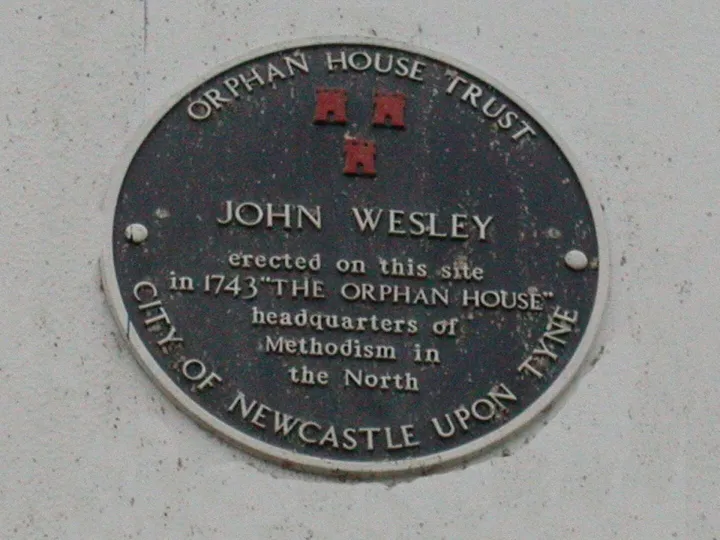
The Orphan House, the site of which is marked by a plaque on Barclays bank in Northumberland Street, was situated at a spot which in 1742 was outside the Pilgrim Street Gate. It cost £700 and was ready for use by the spring of 1743. Despite its name the building was never used as an orphanage, but served as a place of worship, a northern home for Wesley, an educational institution for Wesley’s preachers, and a medical dispensary for the poor. Wesley, who visited the city on many occasions up to the year before his death in 1791 and was genuinely, attached to the townsfolk, recorded in his journal ‘I know no place in Great Britain comparable to it for pleasantness.’
To complete the story of the Orphan House it may be noted that in 1825 an infant school was opened there by the Newcastle Infant School Society. In due course the Orphan House Buildings became redundant and were finally demolished in 1957.
The Building of Brunswick Chapel
A Growing Methodist Community and the Chapel Established in 1821
By the early 19th century, the Orphan House could no longer accommodate the growing number of worshippers, and it was decided to purchase land in Brunswick Place as the site for a new chapel.
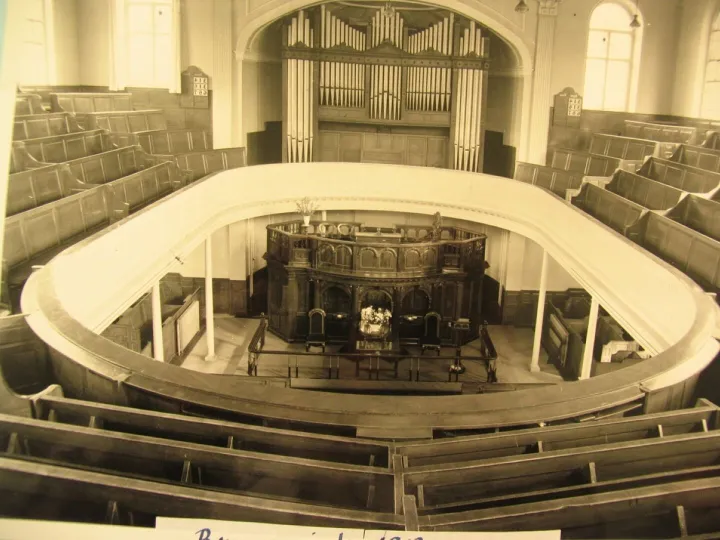
The corner stone of the chapel, the design of which was based on that of the recently built Waltham Street Chapel in Hull, was laid on 5th May 1820, and the completed building, which cost £6,726, was ready for use by February 1821. It was named ‘Brunswick’ as a statement of allegiance to the Hanoverian Dynasty, the House of Brunswick as the Prince Regent had been influential in promoting the New Toleration Act of 1812 which gave the legitimacy to Methodists, among other denomination groups.
Brunswick has nurtured many illustrious names well known in the North East, such as Bainbridge, Fenwick and Grainger.
Records of the 19th century reveal some interesting facets of the Victorian Society of which our antecedents were a part. The membership, of which there were at one time some 770 persons, comprised three distinct classes: the gentry, who sat in box pews at the front of the gallery; the middle classes, who sat in other pews in the gallery and were businessmen or tradespeople; the lower orders, who occupied the centre part downstairs and were often artisans. Occupations included: keelmen, bottle makers, surgeon, pitmen, sailors, as well as, of course, gentlemen. Many reflect the trades which were peculiar to Tyneside. Their addresses reveal the fact that in those days many streets now associated only with trade were residential, such as the Side, Pilgrim Street, Castle Garth and Brunswick Place itself.
Because Brunswick was one of the largest public buildings in Newcastle in Victorian times, it was used not only for worship but also for large public meetings, notably those promoted by the anti-slavery movement.
Renewal and Reconstruction
The Transformation of Brunswick Church in the 1980s
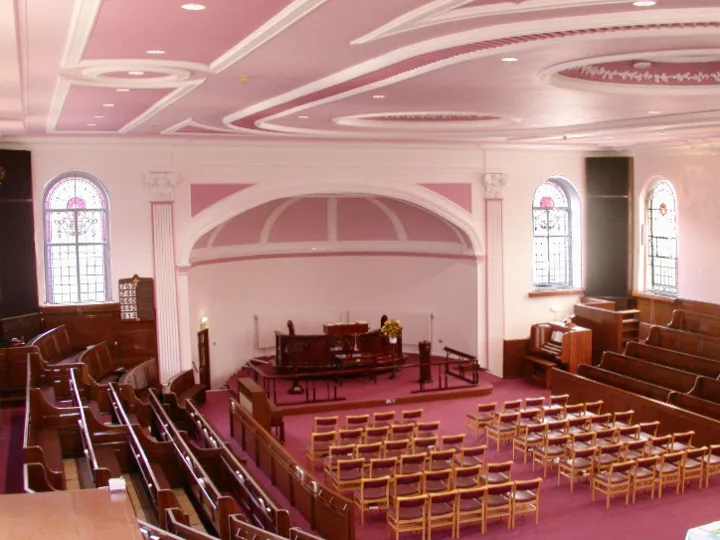
Although Brunswick Church had, with the passage of time, undergone internal modifications, none was to match the reconstruction which was undertaken at the beginning of the 1980’s.
The worship area was raised to first floor level and made more flexible in its use; the ground floor now comprised a small Chapel for use by anyone wishing for solitude and prayer throughout the week, an exhibition area and coffee shop and a church hall.
The people of Brunswick devised a three-fold commitment in 1981:
- A commitment to stay at the centre of the city and remain a focal point for witness there;
- A commitment to tell the unchanging Gospel of Jesus Christ through work and worship;
- A commitment to care for all who come through our doors and to offer ministry from our staff, supported by lay volunteers.
Brunswick Today
Continuing Brunswick’s Commitment to Worship, Welcome and Witness
This threefold commitment still lies at the heart of all that Brunswick Church seeks to do today as we open our doors seven days a week to be a place where the story of God can be encountered. We seek to be a community of grace, hospitality and welcome where all can discover the love of God.
Quick Links
Contact Us
fiona@brunswickmethodist.org.uk / 0191 2321692 /
Brunswick Place, Newcastle Upon Tyne, NE1 7BJ